Sports Psychology for Musicians: Is It The Right Choice for You?

Updated: Jul 25

* Where I describe clients in my blog posts, I've changed names, instruments, and other identifying details to protect their privacy. Sometimes I'm describing one person, sometimes a pattern I've seen across several. The essence of the experience and what we worked on together remain true.
A musician I worked with arrived having already done everything.
And she had a list:
A sports psychologist for musicians. Then a mental coach who'd built his whole practice with elite competitors in another field. Mock auditions, recorded and reviewed. Books, which she described to me as "dozens".
And it had worked.
She was clear that she'd learned a great deal from all of them and that she'd got to, in her words, a good enough place. She was also clear that a good enough place wasn't enough to perform the way she wanted to.
We spent a while working out what was actually missing, and what we landed on was freedom.
Because she was "functional under pressure", and functional is fine, right up until it turns into over-control. She'd built herself a set of checklists and a sequence to follow, and the sequence worked. She could get through the concert. But what she'd noticed was that the playing coming out the other side was technically okay and completely flat. Not expressive. Not, by her own standard, impressive.
That gap is the thing this post is about.
Before we go any further, let me get this out of the way:
Sports psychology was my way into all of this. It's where I first came across the idea that the mental side of performing is something you can study and get better at, rather than something you either have or you don't. The Inner Game books are still among my favorites. A good part of what I do came out of that field. So this isn't going to be a takedown :)
Where Sports Psychology for Musicians Came From
The crossover happened mostly in the 1990s, when peak-performance psychologists who'd spent their careers with athletes started working with musicians, singers, dancers and actors.
Two popular books had paved the way already: Timothy Gallwey's The Inner Game of Tennis in 1974, and Barry Green's The Inner Game of Music twelve years later.
It brought really helpful tools with it. Among many, there are two that I'd want any musician to know about. Because I've never had a client tell me they learned either of these in a music lesson.
Here's the first one:
Individual Zones of Optimal Functioning
Yuri Hanin spent the 1970s and 1980s measuring anxiety in elite athletes, divers and gymnasts and rowers and swimmers, expecting to find the sweet spot. The prevailing model said arousal and performance form an inverted U, so too little and you're flat, too much and you fall apart, and somewhere in the middle everyone does their best work.
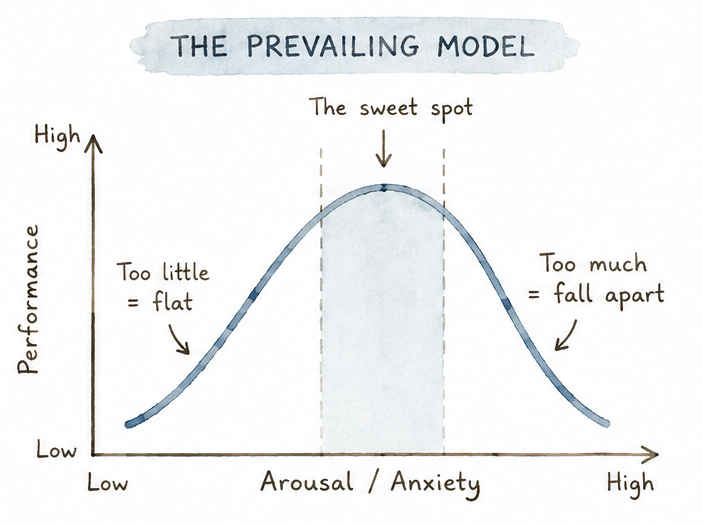
What he found was that the middle is a group average... meaning, it's not the optimal zone for everyone. Each athlete had their own band of emotional intensity in which their best results happened, and those bands sat in wildly different places. Some did their best work keyed up to a level that would have wrecked somebody else. Some needed to be much quieter than the model predicted.

Fun fact: Hanin also stopped sorting emotions into positive and negative and started sorting them into helpful and unhelpful for that particular person. Anger and sadness are unpleasant, yes, but they don't have to derail your performance at all just because they're unpleasant.
For a musician who has spent years being told to calm down before playing, this is a weird reframe, because it says the target was never calm. The target is your optimal band, and finding out where yours sits is an empirical question rather than a moral one. It's been tested on musicians too, including a study on thirty college piano majors.
PETTLEP
Paul Holmes and David Collins published this in 2001 as a seven-point checklist for building imagery that does something: Physical, Environment, Task, Timing, Learning, Emotion, Perspective. The argument is that imagery works to the degree that it resembles the real thing, so you image in performance posture rather than lying down, in a space like the one you'll be in, at real tempo rather than in a comfortable blur, with the emotional content included instead of stripped out. There's a published review of applying it to music specifically.
It's a genuinely useful framework, and there's a trap in it, because the more vivid your imagery gets the more tempting it becomes to image everything going perfectly.
I've explained why visualizing perfection backfires in this post, and PETTLEP done well is a rehearsal of the conditions rather than a rehearsal of a fantasy.
There's evidence behind the general approach as well. Terry Clark and Aaron Williamon ran a nine-week mental skills program at a conservatoire in England with a control group, and the participants came out with more confidence in their ability to perform, more vivid imagery, and different practice habits. It was published in the Journal of Applied Sport Psychology.
So there's plenty of evidence on the usefulness of transferring tools from sports psychology to music performance.
But there's a catch...
Sports psychology optimizes for execution.
That's the field's own word, by the way, and it isn't meant as a criticism.
Do the thing correctly, on demand, when it counts and when your hands are shaking. Which means, land the routine, sink the putt, hold the line.
For an athlete that's the whole target, because execution is the product. Nobody in the stands is hoping to be moved by the eighty-meter mark.
Now think about what your job actually asks for...
Where Music Asks for More
First off, you have to execute too. The notes have to be right, and under conditions that are unreasonable.
But the notes are how the music gets delivered rather than the job itself. What you're there to produce is the story, the connection with whoever's listening, the expression, the emotion, the interpretation that's yours and not the recording you grew up with, and depending on what you play, the improvisation.
All of it has to happen at the same time as the execution, in front of people who've heard the greatest players do the same piece.
It would be easy to treat these as the soft, unmeasurable part of the job. Turns out, they aren't.
Patrik Juslin and Petri Laukka pulled together 41 studies on emotional communication in performance and found that professional performers transmit five emotions to listeners, happiness, anger, sadness, fear and tenderness, with an accuracy roughly comparable to facial expression. The listener receives what the player intended, at rates you can put a number on. Expression is a signal, and it gets through.
And maybe even more importantly, it can be taught. In one study, guitarists were given feedback on how their use of specific cues compared with what listeners actually respond to, and their communication accuracy improved by about half after a single session.
Which means there are two skills here, not one: There's getting it right, and there's getting it across.
And a framework built only for execution will train the first one hard and leave the second one to sort itself out alone.
Two Ways the Aim Problem Costs You
Unfortunately, pointing everything at execution doesn't leave expression untouched. It can actively work against it, and the field already knows this. It just hasn't had much reason to work out what it means for a job where execution isn't the product.
Running on rules
Richard Masters called it reinvestment. Control of a well-learned motor skill gets disrupted when working memory starts manipulating conscious, rule-based, explicit knowledge, and one finding I still find odd is that the more technical information you gathered while learning something, the likelier it is to break down on you under pressure.
That's my client's checklists. A sequence, followed step by step, holding the performance together from the outside. It worked in the sense that she got through, and it was also the thing flattening her, because a mind occupied with running the sequence is not available for anything else.
Watching your own hands
Adina Mornell and Gabriele Wulf ran two experiments with skilled musicians on different instruments, each playing a piece they'd chosen and already mastered. One group was told to focus on the precision of their finger movements, or lip movements for the singers, and on playing the correct notes. Another was told to focus on playing for the audience and on the expressive sound of the music.
Expert raters scored the results. External focus produced better musical expression than internal focus in both experiments. In the second, where the raters worked from more detailed criteria, external focus also produced better technical precision.
So attending to your embouchure, your fingering, your soft palate, your bow contact point, all the things you were trained to attend to, makes the playing less expressive and, when anyone looks closely enough, less accurate as well.
In that sense, when you're technically skilled enough (as in, have the motor skills in your muscle memory), moving attention out towards the sound and the story is not a sacrifice of technical standards. It's how you get both.
There's a part that's even more interesting: The more expert you are, the further out your attention should sit. And under pressure attention tends to pull back in. The situation itself drags you towards the thing that damages your performance.
The Other Thing That Doesn't Transfer
Sport is organized around "peak performance". Training is periodized, built in blocks that arrive at a known date in the best possible shape, and the whole structure assumes recovery on the other side.
You, as a musician, need to do it on a regular Tuesday. Then Wednesday, and maybe even eight times a week. There's no taper and no real off-season.
A survey of 2,316 orchestral musicians found around half saying the pressure to perform was intensifying, and they put it down to growing artistic demands and an expanding workload rather than to anything psychological. As in, you have to show up at a good level every single day.
I've never found much in the peaking literature about an ordinary Thursday when you're tired.
I've written about that at length in why I don't coach for peak performance, if that sounds interesting.
So Is It the Right Choice for You?
Depends where you're starting from.
If you've never done structured mental work, go and do some :)
A sports psychologist or a mental performance coach will hand you things that make a difference immediately. Most of the musicians who come to me haven't done any of it and it's the fastest available improvement.
If it isn't staying on the stage, you want a different profession altogether.
Panic when you're nowhere near a performance, avoidance that's rearranging your ordinary life, depression, a history that keeps turning up in the room, anything that was there before the music or would still be there without it. Coaching isn't treatment and shouldn't pretend to be. Go and find someone with clinical training.
If you've got the tools and the playing has gone flat, that's an aim problem.
My approach is based on Acceptance and Commitment Training (ACT), which means less effort arranging how you feel before you perform and more spent on what you want the performance to be for.
Incomplete Isn't Wrong
Sports psychology gave musicians a set of tools that truly work to improve performance skills, especially under pressure.
It's just that they were built for a job where doing it correctly is the whole of the job, and yours isn't exactly that. So the tools survive the move. But what has to change is what you point them at.
If that sounds like what you need, Performing Under Pressure is my self-paced course, and it's built specifically to give musicians the foundations of mental work.
About
I'm Gökçe Kutsal, a music performance coach for professional orchestra musicians and opera singers, with an MA in Voice Pedagogy, plus coaching and teaching experience since 2017. I work with orchestral musicians, soloists, and audition candidates across Europe, the UK, North America, and Australia — and I write about performance anxiety, audition preparation, and the craft of practice for musicians who already have the technique and are trying to work out why it doesn't always hold up under pressure.
Research Cited
Clark, T., & Williamon, A. (2011). Evaluation of a mental skills training program for musicians. Journal of Applied Sport Psychology, 23(3), 342-359.
Gallwey, W. T. (1974). The inner game of tennis. Random House.
Green, B., & Gallwey, W. T. (1986). The inner game of music. Doubleday.
Gembris, H., Heye, A., & Seifert, A. (2018). Health problems of orchestral musicians from a life-span perspective. Music & Science, 1.
Hanin, Y. L. (1997). Emotions and athletic performance: Individual zones of optimal functioning model. European Yearbook of Sport Psychology, 1, 29-72.
Hanin, Y. L. (2000). Emotions in sport. Human Kinetics.
Holmes, P. S., & Collins, D. J. (2001). The PETTLEP approach to motor imagery: A functional equivalence model for sport psychologists. Journal of Applied Sport Psychology, 13(1), 60-83.
Juslin, P. N., & Laukka, P. (2000). Improving emotional communication in music performance through cognitive feedback. Musicae Scientiae, 4(2), 151-183.
Juslin, P. N., & Laukka, P. (2003). Communication of emotions in vocal expression and music performance: Different channels, same code? Psychological Bulletin, 129(5), 770-814.
Masters, R. S. W. (1992). Knowledge, knerves and know-how. British Journal of Psychology, 83(3), 343-358.
McNevin, N. H., Shea, C. H., & Wulf, G. (2003). Increasing the distance of an external focus of attention enhances learning. Psychological Research, 67(1), 22-29.
Mornell, A., & Wulf, G. (2019). Adopting an external focus of attention enhances musical performance. Journal of Research in Music Education, 66(4), 375-391.
Wright, D. J., Wakefield, C. J., & Smith, D. (2014). Using PETTLEP imagery to improve music performance: A review. Musicae Scientiae, 18(4), 448-463.
Wulf, G. (2013). Attentional focus and motor learning: A review of 15 years. International Review of Sport and Exercise Psychology, 6(1), 77-104.
Yao, Z., & Li, Y. (2022). Preliminary assessment of individual zone of optimal functioning model applied to music performance anxiety in college piano majors. Frontiers in Psychology, 13, 764147.